
fbpx
Holiday Hours Update : In observance of the upcoming holidays, our Contact Support Centers will be open on December 24 until 3:00pm. We will be closed on December 25 and January 1. Wishing you and yours a Merry Christmas and Happy New Year!
HomeImplantsImplant Scan Bodies
implant scan body on dental implant

Scan Bodies in Digital Implant Dentistry​

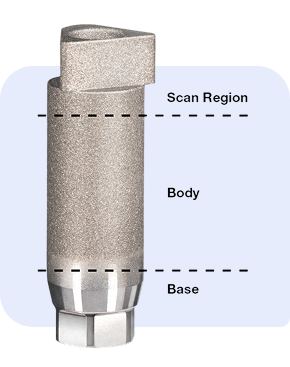
A scan body is an implant component attached to the implant body during digital impression capture.​

Its purpose is to:
  • Communicate implant position in three dimensions​
  • Register rotational orientation​​
  • Allow CAD software to match the implant to its digital library​​
  • Guide the design of the final restoration​​
The scanner does not “see” the implant itself. It reads the geometry of the scan body, and software converts that geometry into the exact implant platform and position.

OEM vs. Inclusive® Titanium Scan Bodies​

OEM scan bodies are made by the implant manufacturer and matched to their implant libraries. If an OEM scan body is used, the restoration will be fabricated with OEM components and billed at OEM pricing.
Inclusive® Titanium Scan Body are compatible with the manufacturer’s implant system. Cases submitted with an Inclusive scan body qualify for our published inclusive pricing. The scan body must match the exact implant system, platform size, and connection type.​
Before scanning, confirm the implant system, platform size, and whether the connection is internal or external.​ ​
digital implant scan body geometry capture

Available Inclusive Titanium Scan Bodies​

  • Dentsply Sirona – Ankylos, Astra, Astra EV​
  • Hiossen
  • Keystone Dental – PrimaConnex​
  • MegaGen​
  • Neoss​
  • Nobel Biocare – Branemark, NobelActive, NobelReplace​
  • Straumann – Straumann Tissue Level, Straumann Bone Level​
  • Zimmer Biomet – Zimmer, Biomet 3i
If you are using an Inclusive Titanium Scan Body, your case qualifies for our published inclusive pricing structure.

Compatible Systems​

We restore implant systems that are legally serviced and distributed in the continental U.S. If a system cannot be sourced through an authorized U.S. manufacturer or laboratory vendor, we cannot support the case unless the doctor provides all required components.​

Frequently Asked Questions

What is the length of the Inclusive® Titanium Scan Body?​
The Inclusive® Titanium Scan Body is manufactured in a 12 mm length. This standardized length is designed to perform reliably across all intraoral scanning systems and digital workflows.​
Can scan bodies be sterilized and reused?​

Sterilization and reuse depend on the material and manufacturer guidelines.​

  • Inclusive® Titanium Scan Bodies can tolerate sterilization; however, single-patient use is generally recommended to minimize the risk of cross-contamination​
  • Many PEEK scan bodies are intended for single-patient use.​

Always follow the manufacturer’s Instructions for Use (IFU) for proper cleaning and sterilization protocols​

Should the scan body be removed before taking the bite?

In many workflows, yes. Removing the scan body before recording maximum intercuspation helps ensure the occlusal relationship is captured accurately without interference.​

Why isn’t my scanner recognizing the scan body?​

Common causes include:​

  • Incorrect implant library selected​
  • Incomplete scan body geometry capture​
  • Debris, blood, or saliva covering the scan body​
  • Using the wrong scan body for the implant platform​

Verify implant compatibility and rescan if necessary.​

What causes implant restoration misfit in digital workflows?

The most common causes include:​

  • Incomplete scan body seating​
  • Incorrect platform or implant selection​
  • Incomplete geometry capture​
  • Soft tissue interference​
  • Failure to verify the scan before submission​

Most implant remakes originate from scanning errors — not laboratory design.​

What should I check before  submitting an implant scan?

Before submitting your case, confirm:​

  • Full scan body geometry is captured​
  • The correct implant system and platform are identified​
  • Adjacent contacts are clearly recorded​
  • Soft tissue contours are visible​
  • Bite registration is accurate​

A 30-second review can prevent costly adjustments and remakes.​